Student-teacher relationships: Why emotional support matters
© 2022 – 2022 Gwen Dewar, Ph.D., all rights reserved
 opens IMAGE file
Supportive educatee-instructor relationships boost achievement, and protect kids from the effects of stress. Merely many students don't get the adventure to form such bonds. What can we practice to help?
Imagine 120 children, half-dozen-year-olds seated at computers.
Every bit part of an experiment, the kids are taking a series of cognitive tests.

But the researchers aren't trying to figure out who's smarter. They're trying to notice out if student-teacher relationships affect the way kids think.
So the researchers accept taken photographs of all the children's teachers. And just before existence given a new problem to solve, each child is shown his or her teacher'due south face up.
The epitome appears only for a split second, a time span so brief the kids aren't even enlightened of what they've seen. It's subliminal. Simply it has an effect, because the kids who have shut, affectionate teacher relationships — as opposed to afar ones — cease up solving many problems faster (Ahnert et al 2012).
The correlation holds up fifty-fifty when you compare kids in the same class. So it's non just about differences in curricula or other classroom characteristics.
Information technology seems to be about something more than specific, something peculiar to each educatee-teacher relationship. And at that place may be long-lasting consequences.
In the weeks that follow, the children — German kids who've been attending what English-speakers might phone call "preschool" or "nursery school" — begin their outset year of elementary school.
The researchers wonder. Do the old relationships still matter? Are the new relationships also linked with problem-solving speed?
To answer these questions, Liselotte Anhert and her colleagues examination many of the children again, five-6 months later — this time with photos of both their quondam, preschool teachers and their new, main school ones. What happens?
Subliminal images of supportive preschool teachers withal have a positive effect. Images of supportive primary schoolhouse teachers practice not.
The affect of student-instructor relationships
Experiments like these eternalize our intuitions. Secure, supportive relationships are peculiarly of import for young children, and may have far-reaching consequences.
But what about older kids? The German experiments seem consistent with the idea that the personal equation matters less as children get older. Only at that place are other explanations.
Most of the children in this study had known their preschool teachers for years — much longer than they had know their primary school teachers. Perhaps kids demand more fourth dimension to feel personally connected.

And here'due south another possibility: Pupil-teacher relationships, fifty-fifty friendly, supportive ones, tend to presume a less nurturing, less physical aspect as kids movement from preschool to master school. Might kids suffer for it? Given what's known almost the benefits of affectionate touch, information technology seems plausible.
But regardless of how we business relationship for these "speed-of-problem-solving" results, we should go on in listen:
Secure, supportive student-teacher relationships are linked with a variety of beneficial effects, and these continue beyond preschool.
For instance, the same researchers who conducted the "subliminal teacher" experiments as well measured children'sstress hormone levels.
How supportive teachers protect children from stress
The researchers analyzed daily fluctuations of the hormone, cortisol, every bit the children went through a typical calendar week in simple school. They learned that nigh kids began the school week with fairly normal stress hormone profiles, but showed increasingly atypical patterns as the week progressed — a sign that these kids were under strain.
Past contrast, a subset of children — kids in supportive, secure student-instructor relationships — maintained normal stress hormone patterns throughout the week (Anhert et al 2012).
That suggests that positive relationships have a measurable impact in the short-term, even among elementary school children. And at that place is more.
Kids who experience high quality student-teacher relationships in the early on years tend to have fewer beliefs problems after (Hamre and Piata 2001; Rudasill et al 2010).
They show more engagement in the classroom (Wu et al 2010; Hughes et al 2012), and develop ameliorate language skills (Spilt et al 2015; Schmitt et al 2012; Maldonado-Carreño and Votruba-Drzal 2011).
At that place's also evidence that supportive student-teacher relationships influence the manner kids go treated by peers.
In a report of 336 American school children, kids who were actively rejected by their peers at the get-go of the school year experienced less bullying subsequently on — if they had better-than-boilerplate relationships with their teachers (Christian Elledge et al 2015).
Can we attribute all these happy outcomes to educatee-teacher relationships? Not necessarily. Teachers are man beings like the rest of the states. They find it easier to maintain positive relationships with kids who are cooperative, attentive, socially adept.
Moreover, kids with strong exact skills and high levels of self-control are more probable to succeed in both the social and academic domains.
And so we can't presume that positive student-teacher relationships cause better classroom engagement or fewer behavior problems. Sometimes it's the other way around.

Simply researchers are well aware of these complexities, and endeavor to take them into business relationship.
Student-teacher relationships in the early on years have predicted outcomes afterward, even later researchers control for relevant baseline kid characteristics like attending deficits, defiance, socioeconomic status, and IQ (Hamre and Piata 2001; Rudasill et al 2010; Wu et al 2010; Hughes et al 2012).
Furthermore, kids who struggle aren't doomed to poor outcomes. When teachers maintain supportive relationships with students at special chance for beliefs problems, those kids meliorate over time.
In fact, studies suggest that "at risk" students aremore likely than other kids to benefit from supportive student-teacher relationships.
The takeaway?
It's hard to escape the implications of these studies. Positive student-teacher relationships can protect students from toxic stress. They may forestall behavior problems, enhance a child'southward academic prospects, buffer kids from the risk of peer victimization.
And the benefits don't dwindle abroad as children grow up. On the contrary.
In a meta-assay of 99 published studies, investigators found that, relative to older students, kids in primary school suffered more setbacks when educatee-teacher relationships were negative. But positive relationships were peculiarly benign to older students, and overall, "stronger furnishings were found in college grades" (Roorda et al 2011).
Indeed, in 1 large report of American teens, the unmarried most important school-based predictor of academic growth in mathematics — from the 8th to 12th grades — was a student's perception of "connectedness" with his or her teachers (Gregory and Weinstein 2004).
But that's non all. Close personal relationships do good teachers too.
When students and teachers feel a connection, it isn't only the students who benefit.
Research suggests that teachers feel a greater sense of personal accomplishment when they written report having shut relationships with their students. And when their relationships involve less disharmonize, teachers experience less emotional exhaustion (Corbin et al 2019).
So how practise we ensure that students and teachers develop these crucial, supportive relationships?
The fact is that all students don't get equal handling. They don't get an equal opportunity to forge shut, supportive relationships with their teachers.
That'due south considering teachers are human beings subject to stresses strain, and the educational activity profession is a stressful one.
In improver, teachers often lack training in the best ways to handle discipline.
And teachers, similar the rest of us, suffer from unconscious biases that touch on the style they respond to children.
So we need to become serious virtually helping teachers and students overcome these barriers. Permit'due south have a closer look at the bug.
one. We demand to assistance teachers cope with chore stress

Building positive student-teacher relationships requires patience and good sense of humor — qualities that tend to fizzle out when yous're feeling stressed. And unfortunately, education is a stressful profession.
For instance, in the U.s.a., a report of an urban, Midwestern school district found that 93% of elementary teachers were "highly stressed," and i third of these teachers were experiencing moderate to high levels of burnout (Herman et al 2018).
A subsequent study of Midwestern centre school teachers reported similarly grim statistics (Herman et al 2019).
In the United Kingdom, one survey of schoolhouse teachers found that "psychosocial working conditions were at a poor level" (Ravalier and Walsh 2018). Another U.Thou. opens in a new windowsurvey reports that more than half of all teachers have considered leaving the profession because of "mental health and well-existence pressures."
So if we want to assistance teachers develop positive relationships with their students, we need to accost sources of job stress, like poor authoritative support, poor teacher-parent communication, and insufficient funding.
In a large U.S. written report, positive student-instructor relationships were more than common for kids who had parents who stayed in frequent contact with teachers. In add-on, uncomplicated school students were more likely to maintain positive teacher relationships over time when their teachers received higher salaries (O'Connor 2010).
2. Nosotros need to provide teachers with specialized grooming for coping with defiance and confusing classroom beliefs.
It's clear that teachers need and deserve professional guidance for handling classroom conflicts in positive ways. When experts in holland and the The states have offered such specialized training, student-teacher relationships take improved (Spilt et al 2012b; Capella et al 2012).
3. Schools need to promote practices that make students feel supported and encouraged, not embarrassed and shamed.
There is adept evidence on this point: Teachers should use positive, effective feedback, and avert personal criticism that shames, demeans, or belittles students.
For case, in recent experiments, British children (aged vii-11 years) were presented with ii dissimilar kinds of teacher criticism.
1 involved personal criticism (e.g.,"I'thousand disappointed in you.")
The other was focused on the behavior that the teacher wanted to correct ("Tin can yous recall of a better way to do it?")
Did the type of approach matter? It seems to have made a difference to children's perceptions (Skipper and Douglas 2015).
The kids who received personal criticism concluded that their teachers liked them less, and the experience cast a long shadow: Even subsequently success in a subsequent task, the kids continued to view their educatee-teacher relationship in a negative lite.
Such results are consistent with studies of younger children. Certain types of opens in a new windowcriticism can sap motivation, leaving kids feeling disheartened, frustrated, or helpless.
And as I've argued elsewhere, opens in a new windowclassroom behavior charts — and other disciplinary techniques that publicly embarrass children — might likewise have this upshot.
Practice these techniques undermine pupil-teacher relationships?
I can't notice any studies addressing this for children. But studies of college undergraduates confirm that combative teacher behaviors — like embarrassing students, or dismissing their contributions — turn students off.
They respond more than negatively to teachers, and go less engaged in the textile. And these effects are evident even when students aren't themselves the target of a instructor's antagonism. Observing the embarrassment of other students is enough (Broeckelman-Post et al 2015; Goodboy et al 2018).
4. We need to railroad train teachers to identify and counteract biases
Teachers are merely man. So like the residuum of us, they harbor social biases they've absorbed from the popular culture — stereotypes that can pitter-patter into our thinking whether or not we're consciously enlightened of it.
And unfortunately, these implicit biases can give rise to stark inequalities in how students are treated.
For example, Jason Okonofua and his colleagues have documented "farthermost racial disparities in school disciplinary action in the United States," and the researchers accept confirmed one of import cause: Teachers tend to perceive the misbehavior of Black students equally more troubling (Okonofua et al 2016b).
In experiments, teachers who were asked to make judgments about hypothetical students were more likely to recommend severe penalisation for repeat offenders who were Black, rather than White (Okonofua and Eberhardt 2015).
The descriptions of the students — and their classroom beliefs — was identical. Only their racial identities were dissimilar, and that was plenty to trigger biased reactions in the teachers.
Children may likewise exist treated differently depending on other factors, like socioeconomic status. For instance, a contempo experiment in Switzerland plant that teachers were more likely to assign students of lower socioeconomic status to lower academic tracks — fifty-fifty when their academic records were identical with those of high socioeconomic status students (Batruch et al 2018).
So social biases can create major barriers to the development of quality educatee-teacher relationships. How can we prepare the problem, and address this fundamental unfairness?
The good news is that implicit biases don't take to dictate how we acquit. They merely represent our knee-jerk reactions — the conclusions that our unconscious minds jump to before we use our deliberative, conscious minds to mull the question over.
So we tin override our knee-jerk reactions, but we have to actively monitor ourselves, and brand a practise of questioning our initial reactions.
So what? We need to do empathy, and have a constructive problem-solving arroyo to perceived misbehavior.
When Jason Okonofua and his colleagues coached centre schoolhouse teachers to supercede punitive discipline policies with empathy and problem solving, student-teacher relationships improved. And school suspension rates were cut in half (Okonofua et al 2016a).
Employing the principles of opens in a new window"positive parenting" in the classroom can aid ensure that every child gets the support he or she deserves.
5. We need to help teachers bridge the culture gap
Sometimes students and teachers come up from the aforementioned cultural background. Simply often they don't, and that can touch the quality of communication.
For example, people from unlike cultures express emotion in somewhat unlike ways, and it tin lead to missed signals.
When researchers compared Turkish immigrant teachers with native Dutch teachers, they found that Turkish immigrant teachers were more likely to detect anxiety and depression in Turkish immigrant children. Native Dutch teachers didn't pick up on the same cues (Crijnen et al 2000).
And cultural differences can touch on the way we use and translate language, leading to central misunderstandings.
Writing about the United states of america in 1988, educational researcher Lisa Delpit noted that the White American teachers she observed addressed their students in a roundabout way. Verbal directives were couched as suggestions or questions, like, "Is this where the scissors belong?"
By dissimilarity, Delpit wrote, many Black American teachers stated the bulletin more directly, (due east.yard., "Put those scissors on that shelf,") and the difference may accept had important consequences.
Kids who'd been raised to respond to explicit directives may not have recognized a teacher's question for what information technology really was – a veiled command. Kids accustomed to indirect commands may have interpreted imperative linguistic communication ("Exercise this") as harsh or angry. Either way, there was potential for misunderstanding and trouble.
And so we demand to realize that pedagogy isn't as straightforward equally it may seem. Teachers demand to tune into the cultural assumptions of their students, and parents need to communicate with teachers almost misunderstandings they perceive. Taking the time and effort to learn nigh cultural differences isn't a frill. It'due south crucial to successful pedagogy.
And what should we do when a relationship just isn't working?
When — despite our best efforts — relationships don't meliorate, I think we're justified in considering the option of classroom re-assignment. For some kids, there is lot at stake.
And for the balance of us, it's time to reconsider the way our schools are organized.
For example, is early on education too regimented for naturally restless young children? Especially young boys?
During the early years of schooling, girls outperform boys in attentiveness, task persistence, impulse control, and social skills (McWayne et al 2004; Rimm-Kaufman et al 2009). Equally a result, girls may discover information technology easier to suit to schoolhouse, which could explain why girls are more than likely to forge high quality relationships with teachers (Mulolla et al 2012).
Do we simply accept this as the way of the earth, or do nosotros determine to change the nature of early schooling so that it'due south easier for young children to cooperate and follow the rules?
And what most schoolhouse policies that forbid teachers from offer physical reassurance to their students — like a pat on the shoulder? Exercise such rules interfere with the development of quality educatee-instructor relationships?
What about the expectations of mainstream, secondary schools — where students are bustled from classroom to classroom, rarely getting the adventure to develop personal relationships with their teachers? Are we depriving students an important source of motivation and resilience?
These are questions worth asking.
References: Student-teacher relationships
Ahnert L, Milatz A, Kappler G, Schneiderwind J, and Fischer R. 2013. The touch on of teacher-child relationships on child cerebral operation as explored past a priming paradigm. Dev Psychol. 49(3):554-67.
Ahnert Fifty, Harwardt-Heinecke Due east, Kappler M, Eckstein-Madry T, and Milatz A. 2012. Student-teacher relationships and classroom climate in first grade: how do they relate to students' stress regulation? Attach Hum Dev. 14(three):249-63.
Barber BK and Olsen JA. 2004. Assessing the transitions to eye and high school. Journal of Adolescent Inquiry. 19:3–xxx.
Batruch A, Autin F, Bataillard F, and Butera F. 2018. Schoolhouse Selection and the Social Course Divide: How Tracking Contributes to the Reproduction of Inequalities. Personality and Social Psychology Bulletin.
Broeckelman-Post MA, Tacconelli A, Guzmán J, Rios M, Calero B and Latif F. 2016. Teacher Misbehavior and its Effects on Pupil Interest and Engagement Communication Education, 65(ii): 204-212 2016.
Buyse E, Verschueren K, Doumen Southward, Van Damme J, and Maes F. 2008. Classroom trouble behavior and teacher-child relationships in kindergarten: the moderating part of classroom climate. J Sch Psychol. 46(iv):367-91.
Christian Elledge Fifty, Elledge AR, Newgent RA, and Cavell TA. 2015. Social Chance and Peer Victimization in Uncomplicated Schoolhouse Children: The Protective Role of Teacher-Student Relationships. J Abnorm Child Psychol. 2022 Sep 4. [Epub ahead of print]
Corbin CM, Alamos P, Lowenstein AE, Downer JT, Brown JL. 2019. The function of instructor-pupil relationships in predicting teachers' personal achievement and emotional exhaustion. J Sch Psychol. 77:i-12.
Crijnen AA, Bengi-Arslan L, and Verhulst FC. 2000. Teacher-reported trouble behaviour in Turkish immigrant and Dutch children: a cantankerous-cultural comparison. Acta Psychiatr Scand. 102(vi):439-44.
de Wilde A, Koot HM, and van Lier PA. 2015. Developmental Links Betwixt Children's Working Memory and their Social Relations with Teachers and Peers in the Early School Years. J Abnorm Child Psychol. [Epub alee of impress].
Delpit LD. 1988. The silenced dialogue: Power and pedagogy in educating other people's children. Harvard Educational Review 58(three): p.280.
Goodboy AK, Bolkan S, and & Baker JP. 2018. Instructor misbehaviors impede students' cognitive learning: testing the causal assumption. Communication Pedagogy DOI: 10.1080/03634523.2018.1465192
Gregory A and Weinstein RS. 2004. Connection and Regulation at Home and in School: Predicting Growth in Achievement for Adolescents. Journal of Boyish Inquiry nineteen(4): 405-427.
Hamre BK and Pianta RC. 2006. Pupil-teacher relationships. In: Deport GC, Minke KM, editors. Children's needs 3: Development, prevention, and intervention. National Clan of School Psychologists; Washington, DC, pp. 59–71.
Hamre BK and Pianta RC. 2001. Early on teacher-child relationships and the trajectory of children's school outcomes through eighth grade. Child Dev. 72(2):625-38.
Herman KC, Hickmon-Rosa J, Reinke WM. 2017. Empirically Derived Profiles of Instructor Stress, Burnout, Self-Efficacy, and Coping and Associated Student Outcomes. Journal of Positive Behavior Interventions 20 (ii): 90.
Herman KC, Prewett SL, Eddy CL, Savala A, and Reinke WM. 2019. Profiles of middle school instructor stress and coping: Concurrent and prospective correlates. Journal of Schoolhouse Psychology 78: 54-68.
Hughes JN, Wu JY, Kwok OM, Villarreal Five, and Johnson AY. 2012. Indirect Furnishings of Child Reports of Teacher-Student Human relationship on Achievement. J Educ Psychol. 104(2):350-365. Epub 2022 Nov 21.
Lisonbee JA, Mize J, Payne AL, and Granger DA. 2008. Children'due south cortisol and the quality of teacher–child relationships in kid intendance. Child Dev. 79(6):1818-32.
Maldonado-Carreño C and Votruba-Drzal E. 2011. Teacher-child relationships and the development of academic and behavioral skills during uncomplicated school: a within- and between-child analysis. Child Dev. 82(2):601-16.
McWayne CM, Fantuzzo JW and McDermott PA. 2004. Preschool competency in context: an investigation of the unique contribution of child competencies to early academic success. Dev Psychol. 40(4):633-45.
Mullola Southward, Ravaja N, Lipsanen J, Alatupa S, Hintsanen Thou, Jokela One thousand, and Keltikangas-Järvinen L. 2012. Gender differences in teachers' perceptions of students' temperament, educational competence, and teachability. Br J Educ Psychol. 82(Pt ii):185-206.
O'Connor E. 2010. Teacher-child relationships as dynamic systems. J Sch Psychol. 48(3):187-218.
Okonofua JA and Eberhardt JL. 2015. Two strikes: race and the disciplining of young students. Psychol Sci. 2022 May;26(5):617-24.
Okonofua JA, Paunesku D, Walton GM. 2016a. Cursory intervention to encourage empathic discipline cuts pause rates in half amidst adolescents. Proc Natl Acad Sci U S A. 113(nineteen):5221-6
Okonofua JA, Walton GM, Eberhardt JL. 2016b. A Vicious Cycle: A Social–Psychological Account of Farthermost Racial Disparities in School Discipline Perspect Psychol Sci. 11(3):381-98.
Ravalier JM and Walsh J. 2018. Working conditions and stress in the English education organisation. Occup Med (Lond). 68(2):129-134.
Rimm-Kaufman SE, Curby TW, Grimm KJ, Nathanson L, Brock LL. 2009. The contribution of children's self-regulation and classroom quality to children'south adaptive behaviors in the kindergarten classroom. Dev Psychol. 2009 Jul;45(4):958-72.
Roorda DL, Koomen HMY, Spilt, JL, and Oort FJ. 2022 The Influence of Melancholia Teacher–Educatee Relationships on Students' School Engagement and Achievement. Review of Educational Enquiry 81 (4): 493-529.
Rudasill KM, Reio TG Jr, Stipanovic Northward, and Taylor JE. 2010. A longitudinal study of student-teacher relationship quality, difficult temperament, and risky behavior from childhood to early on adolescence. J Sch Psychol. 48(v):389-412.
Saft EW and Pianta RC. 2001. Teachers' perceptions of their relationships with student: Effects of child age, gender, and ethnicity of teachers and children. School Psychology Quarterly 16:125–141.
Schmitt MB, Pentimonti JM, and Justice LM. 2012. Teacher-child relationships, behavior regulation, and language gain among at-adventure preschoolers. J Sch Psychol. 50(5):681-99.
Skipper Y and Douglas Chiliad. 2015. The influence of teacher feedback on children's perceptions of student-teacher relationships. Br J Educ Psychol. 85(three):276-88.
Skalická V, Belsky J, Stenseng F, and Wichstrøm L. 2015a. Preschool-historic period problem behavior and teacher-kid conflict in school: directly and moderation effects by preschool organisation. Child Dev. 86(iii):955-64.
Skalická V, Belsky J, Stenseng F, and Wichstrøm Fifty. 2015b. Reciprocal Relations Betwixt Student-Teacher Relationship and Children'southward Behavioral Issues: Moderation by Child-Care Group Size. Child Dev. 86(five):1557-lxx.
Spilt JL, Koomen HM, Harrison LJ. 2015. Language development in the early schoolhouse years: the importance of close relationships with teachers. Dev Psychol. 51(2):185-96.
Spilt JL, Hughes JN, Wu JY, and Kwok OM. 2012a. Dynamics of instructor-student relationships: stability and change beyond elementary school and the influence on children'due south academic success. Child Dev. 83(4):1180-95.
Spilt JL, Koomen HM, Thijs JT, and van der Leij A. 2012b. Supporting teachers' relationships with disruptive children: the potential of human relationship-focused reflection. Attach Hum Dev. xiv(3):305-18.
Spilt JL, Koomen HM, and Jak S. 2012c. Are boys better off with male and girls with female teachers? A multilevel investigation of measurement invariance and gender match in teacher-educatee relationship quality. J Sch Psychol. fifty(three):363-78.
Thijs J, Westhof South, and Koomen H. 2012. Ethnic incongruence and the student-teacher relationship: the perspective of ethnic bulk teachers. J Sch Psychol. fifty(2):257-73.
Vancraeyveldt C, Verschueren K, Wouters S, Van Craeyevelt S, Van den Noortgate Due west, and Colpin H. 2015. Improving teacher-kid relationship quality and teacher-rated behavioral adjustment amid externalizing preschoolers: effects of a two-component intervention. J Abnorm Child Psychol. 43(2):243-57.
Wu JY, Hughes JN, and Kwok OM. 2010. Teacher-student relationship quality type in uncomplicated grades: Furnishings on trajectories for accomplishment and engagement. J Sch Psychol. 48(5):357-87.
———————————–
Photograph credits:
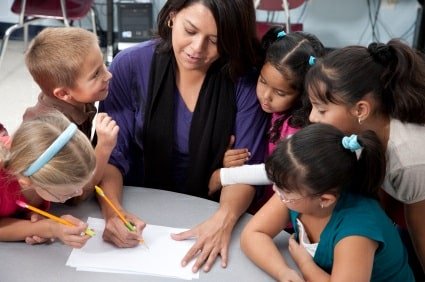
Championship prototype of instructor surrounded by young children by Jani Bryson / istock
Paradigm of children in computer lab by monkeybusinessimages
Epitome of student-teacher hug by Julio Nohara / wikimedia eatables
Image of high school instructor and student past monkeybusinessimages
Image of pensive male child by Charmaineswart / wikimedia commons
Image of students at blackboard past Masae / wikimedia commons
Content last modified 2/2020
Source: https://parentingscience.com/student-teacher-relationships/
0 Response to "Student-teacher relationships: Why emotional support matters"
Post a Comment